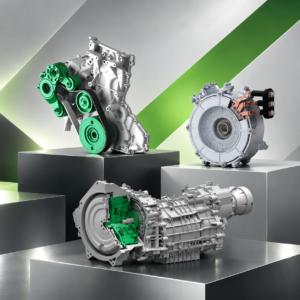
MUVIQ, a global automotive NVH and powertrain engineering company, designs and manufactures tensioners for light-duty, commercial vehicle, and off-highway applications.
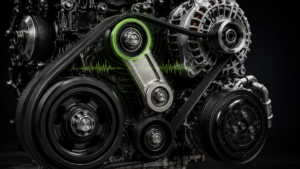
Built to handle the dynamic load demands of modern Front End Accessory Drive (FEAD) systems, MUVIQ tensioners are developed to maintain consistent belt tension across the full engine operating range, from cold start to sustained high-load operation.
What the Tensioner Does
In a serpentine belt drive system, the tensioner plays a critical role in maintaining consistent belt performance and system reliability by:
-
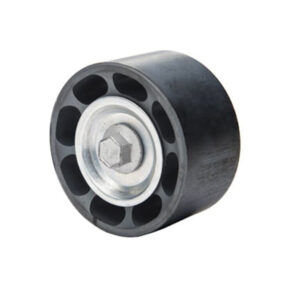
Maintaining belt load within a defined tension window through a spring-loaded pivot arm and precision bearing-mounted pulley.
-
Continuously compensating for changing accessory loads, including high alternator demand, air-conditioning engagement, and
transient engine operating conditions.
-
Preventing belt slip and supporting efficient operation of the accessory drive system.
-
Reducing the risk of belt squeal, premature wear, and accessory drive failure caused by inconsistent belt tension.
-
Managing higher and more frequent load variations in start-stop and mild-hybrid architectures, where tensioner performance becomes increasingly critical.
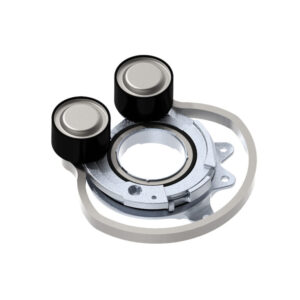
MUVIQ Tensioners: Engineering Highlights
MUVIQ tensioners are developed with application-specific engineering across three primary dimensions:
Bearing Specification
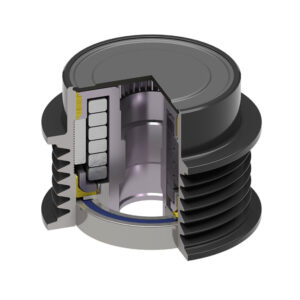
MUVIQ selects deep-groove ball bearings for each application based on operating temperature range, load profile, speed profile, operating conditions, and service-life requirements. Bearing clearance, sealing configuration, and lubricant package are selected according to these requirements to ensure reliable performance throughout the application lifecycle. This ensures that bearing performance reflects actual operating conditions rather than the assumptions of a generic specification.
Spring Rate Calibration
The torsional spring inside the tensioner arm is calibrated to the specific FEAD layout it serves. MUVIQ’s engineering team analyses the engine’s torsional excitation profile and accessory load cycle to specify a spring rate that maintains target belt tension across all operating conditions while avoiding resonance throughout the operating RPM range.
NVH Performance
The NVH performance of the tensioner is evaluated under load, spring-arm oscillation, and pulley-belt contact dynamics. MUVIQ integrates acoustic and vibration analysis into the development process to identify and address NVH contributors before system integration, reducing the risk of late-stage resonance issues during OEM validation.
Applications
MUVIQ tensioners are available for passenger car and light commercial vehicle platforms, as well as commercial vehicle and off-highway powertrains. For 48V mild-hybrid applications with Belt-Starter-Generator (BSG) systems, MUVIQ develops BSG-specific tensioner solutions designed to handle the bidirectional torque loads that energy recovery and torque-assist operation introduce into the belt drive.
OEM and Tier-1 Supply
MUVIQ works with OEM powertrain teams and Tier-1 FEAD system integrators from the application engineering stage through qualification and production. Components are developed under IATF 16949-certified quality management, with Cpk verification for critical dimensions and PPAP documentation as standard deliverables. Engineering support is available throughout the complete programme cycle, from concept to production launch.
Enquire About MUVIQ Tensioners
Contact the MUVIQ engineering team to discuss application requirements, programme timelines, or product specifications.