Introduction
Every powertrain engineer has encountered it a whine at idle, a squeal during cold starts, or a subtle drone that emerges under accessory load. Belt drive noise in automotive systems is one of the more persistent NVH challenges in light vehicle development, and it rarely has a single cause. The front-end accessory drive (FEAD) is a dynamic system, and when one element is out of balance mechanically or dynamically the entire system responds.
What makes belt drive noise particularly tricky is that it sits at the intersection of torsional dynamics, friction mechanics, and structural vibration. Engineers can’t address it by tuning one component in isolation. Understanding how noise originates, where it travels, and how each component in the system influences the outcome is the foundation of any effective solution.
Causes of Belt Drive Noise
The root causes of belt drive noise can be grouped into four main categories. Each one interacts with the others, which is why isolating the source during vehicle testing often takes careful measurement and system-level thinking.
1. Engine Torsional Vibration:
The crankshaft does not rotate at a perfectly constant speed. Internal combustion engines generate torsional pulses with every firing event, and these oscillations propagate outward through the crankshaft pulley into the belt. At certain RPM ranges particularly during idle and low-speed operation the amplitude of these pulses is high enough to induce belt slip, tension fluctuations, and acoustic noise. The fundamental excitation frequency is tied directly to engine firing order, which is why belt noise often has a tonal character that tracks with engine speed.
2. Alternator Inertia:
The alternator is one of the highest-inertia accessories on the drive. Its rotor does not respond instantaneously to belt speed changes driven by crankshaft torsional oscillations. This lag creates a speed differential between the belt and the alternator pulley, which manifests as slip and the audible noise that follows. In systems with stop-start or belt-integrated starter-generator (BSG) functionality, this effect is amplified during engine restart events.
3. Belt Slip and Misalignment:
Belt slip occurs when the friction interface between the belt and a pulley is overcome either by excessive speed differentials, insufficient tension, or surface degradation. Misalignment, even minor axial offset between pulleys, creates edge loading and uneven wear that accelerates both slip and noise generation. Belt tension that is too high introduces its own problems, increasing bearing loads and system-wide vibration.
4. Tensioner Dynamics:
An automatic belt tensioner is supposed to maintain stable belt tension as accessory loads fluctuate. But tensioners have their own resonant frequency, and if the excitation from the crankshaft or accessory pulleys drives the tensioner near resonance, it can oscillate rather than damp. This oscillation changes belt tension cyclically, creating conditions for periodic slip and sustained noise. A tensioner that is not properly damped for the system it operates in is often a contributing factor in recurring belt noise complaints.
System Dynamics: Source, Path, and Response
Analyzing belt drive noise effectively requires thinking in terms of energy flow: source, transfer path, and response. The source is almost always crankshaft torsional vibration. The belt is both a transfer medium and a noise generator; it carries vibrational energy from the crankshaft to each accessory, and it radiates noise when it slips or oscillates laterally. The response is what the vehicle occupant or microphone captures: tonal whine, broad-spectrum drone, or event-based squeal.
The transfer path matters because modifying it is often more practical than eliminating the source. Crankshaft firing pulses cannot be removed; they are inherent to the engine cycle. But their amplitude at the belt interface can be reduced, and their effect on individual accessories can be isolated. This is where the architecture of the FEAD system becomes critical.
Tension variation in the belt is a direct consequence of torsional input from the crankshaft. High-amplitude tension swings fatigue the belt, drive tensioner oscillation, and create the conditions for slip. The system response noise is the sum of all these dynamics playing out in real time.
Key Components and Their Roles
1. Crankshaft Damper:
The crankshaft damper (also called the harmonic balancer or torsional vibration damper) is the first line of defense against torsional excitation. Mounted at the front of the crankshaft, it uses a viscous or rubber-coupled inertia ring to absorb and dissipate
torsional energy before it reaches the belt drive. A damper that is tuned correctly for the engine’s torsional frequency reduces peak amplitude at the crankshaft pulley, which directly reduces belt tension variation and the associated noise. Degradation of the damper rubber
creep, fluid loss, or delamination is a common cause of belt noise that returns after component replacement.
2. Alternator Decoupler Pulley (ADP):
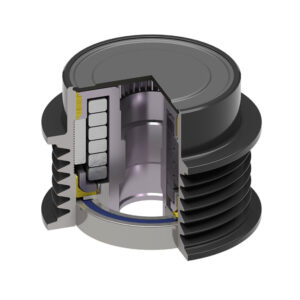
The alternator decoupler pulley is arguably the most impactful single component for addressing belt drive noise on the accessory side. Unlike a solid pulley, the alternator decoupler pulley incorporates a one-way clutch and a torsional spring that allows the pulley to decouple from the alternator rotor during deceleration events. When the crankshaft decelerates as it does between firing pulses at low RPM a solid alternator pulley would back-drive the belt, increasing tension and creating conditions for slip. The ADP’s internal mechanism absorbs this energy instead of transmitting it, keeping belt tension more stable and significantly reducing the noise signature. The ADP also addresses the inertia mismatch problem directly. By allowing the alternator rotor to overrun the belt during deceleration, the speed differential that generates slip is controlled at the component level rather than managed through belt tension alone. In stop-start systems, where restart events create high transient loads on the belt drive, the ADP’s role becomes even more critical.
3. Belt Tensioner:
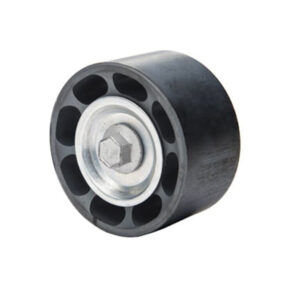
The belt tensioner maintains the working tension that keeps the belt engaged with all pulleys across a range of accessory loads and engine speeds. Beyond static tension, the tensioner’s damping characteristics determine how it responds to dynamic tension fluctuations. A tensioner with insufficient damping will oscillate in response to crankshaft excitation, amplifying rather than attenuating tension swings. Tensioners are typically calibrated for a specific engine and FEAD configuration substituting a tensioner without matching its damping to the system’s dynamic requirements is a common source of field noise issues.
Belt Drive Noise in Light Vehicles: Specific Considerations
Passenger and light commercial vehicles present a particular set of challenges for belt drive NVH. Cabin isolation from the engine compartment is a primary customer expectation, and powertrain noise that would be acceptable in a truck cab is not tolerable in a compact sedan or crossover. Refinement targets have tightened significantly, particularly as electrification has reduced background masking noise in hybrid architectures.
Idle quality is a key battleground. At idle, engine RPM is low, firing pulses are relatively high in amplitude, and the masking effect of wind and road noise is absent. This is where belt whine is most audible and where customers are most likely to notice it. Cold-start conditions compound the issue, belt tension changes with temperature, and accessories that are stiff at low temperatures draw more power, increasing slip risk.
The proliferation of stop-start systems in light vehicles has intensified belt drive demands. Each engine restart event subjects the FEAD to a transient torque spike as the engine fires and the belt re-engages under load. Without appropriate decoupling at the alternator provided by a properly specified alternator decoupler pulley repeated restart events will generate noise and accelerate belt wear.
Engineering Solutions: Component and System Level
Effective belt drive noise reduction requires addressing both the excitation source and the system’s response to it. A component-only approach rarely produces a lasting solution.
At the component level, upgrading from a solid alternator pulley to an alternator decoupler pulley is the single most effective intervention for systems where alternator inertia and slip are the primary noise contributors. The ADP reduces slip events, lowers tension variation, and extends belt life. It should be specified early in the FEAD development process rather than added as a countermeasure after noise targets are missed.
The crankshaft damper tuning must match the engine’s torsional signature. For engines with high torsional amplitude at low RPM typically three- and four-cylinder engines a well-tuned damper significantly reduces the excitation entering the belt drive. Development teams should validate damper performance across the full RPM range and confirm it remains effective over service life.
Belt tensioner selection and calibration should be treated as a system-level decision. Damping coefficient, pre-load, and arm stiffness all affect the tensioner’s dynamic behavior, and these should be optimized for the specific engine and FEAD layout. In systems with high accessory loads or aggressive stop-start duty cycles, dual-tensioner configurations or asymmetric tensioners may be warranted.
At the system level, FEAD layout optimization pulley arrangement, wrap angles, and span lengths affects both the static tension distribution and the dynamic response of the belt. Longer unsupported belt spans are more prone to lateral vibration, and tight wrap angles reduce the friction available to prevent slip. These factors should be evaluated in simulation before hardware is committed.
Conclusion
Belt drive noise is a system-level problem that demands a system-level engineering response. The crankshaft delivers torsional excitation, the belt transmits and amplifies it, and every accessory pulley, especially the alternator has the potential to either absorb or radiate that energy as noise. Understanding the source-path-response relationship is not just an academic exercise; it directly informs which components to target and how to sequence development work.
For light vehicle applications, where NVH refinement targets are stringent and stop-start duty cycles are demanding, the alternator decoupler pulley and crankshaft damper are not optional features; they are foundational to a well-controlled FEAD. Combined with proper tensioner calibration and system-level layout optimization, they give engineers the tools to deliver a quiet, durable belt drive across the vehicle’s full operating life.
About MUVIQ
MUVIQ is a Tier-1 NVH component manufacturer specializing in vibration control solutions for automotive powertrains. The company’s product portfolio covers alternator decoupler pulleys, crankshaft dampers, belt tensioners, and related FEAD components engineered for light vehicle and commercial vehicle applications. MUVIQ partners with OEMs and system integrators at the development stage, providing application-specific NVH engineering support alongside its component supply.