The Pulley Decision That Affects More Than You Think
When engineers specify the alternator pulley for a vehicle accessory drive, it rarely receives the same level of attention as the crankshaft damper or the tensioner. It looks as simple as: “a pulley connects the belt to the alternator shaft.” But how that connection is made has direct consequences for belt drive NVH, belt service life, fuel consumption, and the durability of every component the belt drives.
The two options are a solid (fixed) pulley, where the belt and alternator shaft are rigidly coupled at all times, and an alternator decoupler pulley (ADP), which incorporates a torsional spring isolator and a one-way overrunning clutch. The difference in system behavior between the two is significant, and it becomes even more pronounced as engine downsizing, stop-start systems, and electrification increase the severity of the transients the accessory drive must handle.
This comparison is written for technical buyers and engineers who need to understand the engineering case for each option, where the trade-offs lie, and when investing in an ADP is clearly justified versus when a solid pulley remains adequate.
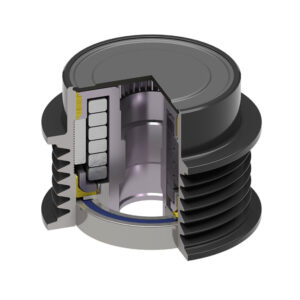
The Mechanical Difference Between a Solid Pulley and an ADP
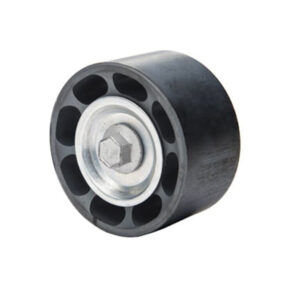
A solid pulley is mechanically simple. It is pressed or bolted onto the alternator shaft and rotates in fixed proportion to belt speed at all times. There is no compliance, no isolation, and no ability to accommodate speed differences between the belt and the alternator rotor during transient conditions.
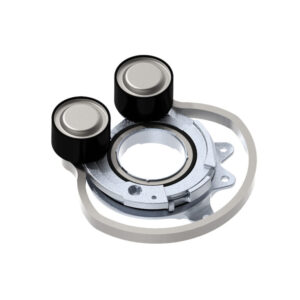
An alternator decoupler pulley adds two mechanisms inside a compact housing. The first is a torsional spring isolator, which introduces compliance between the belt-driven outer race and the alternator shaft. This spring absorbs belt tension fluctuations generated by engine torsional vibration, preventing them from transmitting directly into the alternator shaft as torque spikes.
The second is a one-way overrunning clutch, which allows the alternator rotor to spin faster than the belt during engine deceleration. As the engine slows down, the alternator rotor naturally wants to continue spinning at its previous speed. Without a decoupler, the belt must absorb and brake that inertia, creating tension spikes that strain the belt, tensioner, and other driven components. With a decoupler, the rotor simply overruns until speeds equalise, and the energy is absorbed internally rather than transmitted into the system.
ADP vs Solid Pulley: Side by Side Comparison
|
Feature |
Solid Pulley | Alternator Decoupler Pulley (ADP) |
| Initial Cost | Low | Higher (approx. 2–3x), offset by system savings over service life |
| Belt Longevity | Standard | Extended (up to 2x), due to reduced peak tension and reduced belt slip |
| NVH Performance | Poor (higher vibration) | Superior (smoother operation), absorbs tension fluctuations |
| Tensioner Stress | High | Minimal, rotor overrun reduces inertia load |
| System Efficiency | Lower (higher parasitic loss) | Improved, due to reduced friction across pulleys |
| Stop-Start Suitability | Not recommended | Optimized, eliminates tension spikes |
| BSG / Hybrid Ready | No | Yes, BSG-specific variants available |
Why This Decision Is More Consequential in Commercial and Heavy-Duty Vehicles
In passenger vehicles, ADPs are already widely adopted. Improvements in NVH during stop-start cycles and fuel economy gains made the business case straightforward. The comparison becomes more critical in commercial and off-highway applications, where the same dynamics are amplified by heavier alternators, longer duty cycles, and harsher operating environments.
A commercial vehicle alternator is significantly heavier and has higher rotor inertia than a passenger car equivalent. In applications with frequent stop-start cycles, load switching, or variable operating conditions, deceleration events occur repeatedly, and the energy involved is substantial.
With a solid pulley, these conditions lead to:
-
Accelerated belt fatigue
-
Increased tensioner wear
-
Progressive damage to belt ribs and pulley grooves
A heavy-duty ADP eliminates this energy transfer during deceleration. Over a full service life often 500,000 to 800,000 kilometres in commercial vehicles the reduction in wear and maintenance requirements becomes significant. In most cases, the higher upfront cost of the alternator decoupler pulley is recovered well before the end of the component lifecycle.
The Stop-Start Factor
Stop-start systems create some of the most demanding conditions for the accessory drive.
During engine restart, the belt must accelerate the alternator rotor almost instantly, creating a sharp tension spike. During shutdown, the belt decelerates the rotor, creating another spike. Without a decoupler, these events repeat on every cycle.
An ADP allows the rotor to coast during these transitions, eliminating these spikes. This makes it especially valuable in:
-
Urban delivery vehicles
-
Buses with frequent stops
-
Agricultural and off-highway equipment
-
Hybrid or start-stop enabled systems
Fuel Economy and CO₂ Impact
Reducing belt tension variation lowers the parasitic load on the engine.
Lower tension means reduced friction across pulley contact points, which translates into improved system efficiency. Studies in light-duty vehicles have shown measurable CO₂ reductions from ADP adoption.
In heavy-duty applications, where efficiency gains directly impact operating cost and regulatory compliance, this becomes a meaningful engineering advantage rather than a marginal benefit.
ADPs in Belt-Starter-Generator and Hybrid Architectures
ADPs play a critical role in belt-starter-generator (BSG) systems, where the alternator also functions as a motor for engine restart and torque assist.
In these systems, the alternator switches between generating, motoring, and free-wheeling modes. This introduces torque reversals that the belt system must handle.
BSG-specific ADPs are designed to:
-
Handle bi-directional torque
-
Maintain isolation across all operating modes
-
Support frequent transitions without compromising durability
As hybrid architectures become more common across commercial and off-highway platforms, ADPs shift from being an optional upgrade to a standard requirement in any well-specified accessory drive system.
When to Specify a Decoupler Pulley and When a Solid Pulley Is Still Right
A solid pulley remains suitable for simpler systems with:
-
Light alternators
-
Moderate duty cycles
-
No stop-start requirements
-
Low sensitivity to belt tension variation
In these cases, the cost advantage outweighs the performance difference.
However, an ADP becomes the better engineering choice when:
-
Stop-start or BSG systems are present
-
Alternator inertia is high
-
Load switching is frequent
-
Long service intervals are required
-
NVH targets are strict
In most commercial vehicle applications, these conditions are common. This makes the ADP not only the better technical choice but also the more economical one over the full lifecycle.
Explore MUVIQ’s ADP and FEAD System Portfolio
If your application involves specifying an accessory drive system, MUVIQ offers both light-duty and heavy-duty ADP variants, including BSG-specific designs, along with full FEAD system integration support. Get in touch with our engineering team to discuss your program requirements.
About MUVIQ
MUVIQ is a Tier-1 NVH and vibration control component manufacturer serving OEMs and Tier-1 suppliers across light-duty, commercial, and heavy-duty segments. With a global footprint spanning engineering, manufacturing, and R&D, MUVIQ designs and supplies alternator decoupler pulleys, torsional dampers, tensioners, decouplers, and hybrid system solutions engineered to the NVH, durability, and service life demands of modern vehicle programs.