MUVIQ designs and manufactures automotive idlers for passenger car, light commercial vehicle, commercial vehicle, and off-highway powertrain applications. Developed for integration into modern Front End Accessory Drive (FEAD) systems, MUVIQ idlers support reliable belt routing and contribute to consistent accessory drive performance under a wide range of operating conditions.
The Role of the Idler in the Accessory Drive
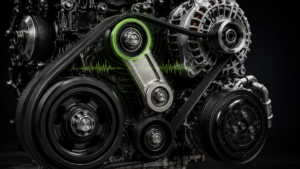
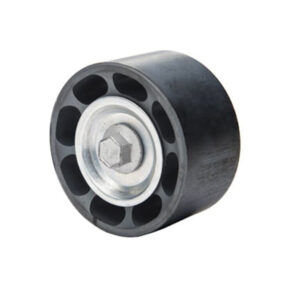
Idlers support belt routing within the Front End Accessory Drive (FEAD) system by controlling belt span geometry, increasing belt wrap around driven accessories, and supporting stable belt operation under varying load conditions. While idlers do not transfer torque, they influence accessory drive packaging requirements, belt dynamics, and overall system performance.
Both drive pulleys and idlers are necessary components within the FEAD system. The performance of an idler depends on factors such as bearing specification, pulley surface geometry, manufacturing quality, and operating conditions. These characteristics directly affect belt system durability, NVH performance, and the service life of adjacent drive components.
Belt chirp, premature belt-edge wear, and accessory drive resonance are among the most common symptoms associated with an idler that is not performing to specification, whether due to bearing degradation, pulley surface geometry variation, or dimensional changes caused by operating conditions.
MUVIQ Idlers: Engineering Highlights
1. Bearing Specification and Sealing
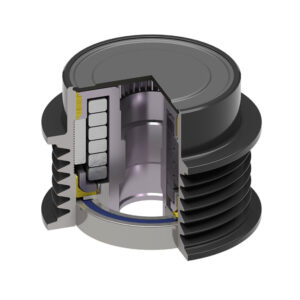
MUVIQ specifies deep-groove ball bearings for idler applications based on rotational speed, load profile, operating conditions, environmental exposure, and service-life requirements. Bearing clearance, sealing configuration, and lubricant selection are defined according to application requirements to support reliable performance throughout the product lifecycle.
2. Pulley Surface Geometry
Running surface geometry, radial runout, and dimensional tolerances are controlled according to application requirements to support stable belt tracking and consistent system performance. These characteristics are specified based on functional requirements rather than generic catalogue standards.
3. Manufacturing and Thermal Stability
MUVIQ applies defined manufacturing and quality-control processes to ensure dimensional consistency and repeatable product performance throughout production. Manufacturing parameters are monitored to support product reliability across a range of operating environments and thermal conditions.
4. NVH Performance
MUVIQ evaluates idler NVH performance under representative operating conditions using acoustic and vibration analysis. Potential NVH contributors are identified during development to support system-level performance targets and OEM validation requirements.
Applications
MUVIQ idlers are available for passenger car, light commercial vehicle, commercial vehicle, and off-highway applications. Product variants are developed according to application requirements, including load conditions, operating environments, packaging constraints, and durability targets.
OEM and Tier-1 Supply
MUVIQ supports OEM powertrain teams and Tier-1 FEAD system integrators from application engineering through production launch. Components are developed under IATF 16949-certified quality management systems, with PPAP documentation and engineering support provided according to programme requirements.
Engineering teams work closely with customers throughout application development, validation, and production planning to support programme objectives and qualification activities.
Enquire About MUVIQ Idlers
Contact the MUVIQ engineering team to discuss application requirements, belt drive layouts, programme timelines, or product specifications.