NVH in Automotive: Why It Matters More Than Ever
Noise, vibration, and harshness (NVH) is one of the most customer-visible quality dimensions in any vehicle. Passengers may not know what a torsional damper is, but they immediately notice the difference between a cabin that feels refined and one that feels rough, buzzy, or fatiguing to sit in for more than twenty minutes.
For automotive engineers, NVH sits at the intersection of structural dynamics, acoustics, and system integration, and getting it right requires understanding where unwanted energy originates, how it travels through the vehicle structure, and which component-level decisions have the most leverage.
This guide is written for engineers who work with NVH daily, whether you are early in a vehicle development program setting targets, mid-program troubleshooting a resonance issue, or in the supplier selection phase evaluating components that will affect NVH across the vehicle’s life. The principles here apply equally to passenger cars and light commercial vehicles, as they do to heavy-duty trucks, buses, and construction equipment, even though the specific frequencies, amplitudes, and engineering constraints differ substantially between those segments.
What NVH Actually Means and Why the Distinction Matters
The three terms are often used interchangeably, but they describe distinct phenomena that require different engineering responses. Noise refers to airborne sound, pressure waves that reach the occupant’s ear either through the air or through structure-borne transmission. Vibration is a mechanical oscillation that is felt rather than heard; it reaches the occupant through the seat, steering wheel, floor, or pedals. Harshness is the subjective quality of short-duration, high-amplitude transient inputs, such as the sharp thud of a road joint or the jolt from a pothole, that feel rough or abrupt rather than smooth.
Understanding which of the three is driving a complaint dictates what kind of investigation and what category of solution is appropriate. A customer complaint about a booming noise at highway speed is a very different engineering problem from a complaint about steering wheel vibration at idle, even though both fall under the NVH umbrella. Treating them with the same diagnostic framework wastes time and often leads to solutions that address the symptom without reaching the source.
 Where NVH Energy Comes From and How It Travels
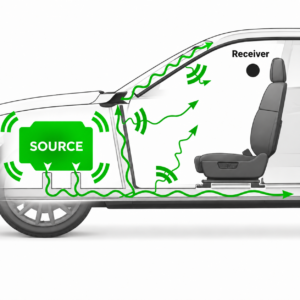
Every NVH problem has three elements: a source, a transfer path, and a receiver. Effective NVH engineering addresses all three, because eliminating the source is not always feasible, and blocking every transfer path is not always practical. The skill lies in understanding which combination of interventions produces the best outcome for a given vehicle program and budget.
Primary NVH Sources in Automotive Powertrains
The engine is the dominant source in most vehicles. Combustion pressure fluctuations create torsional excitation of the crankshaft, which radiates noise and vibration through the engine structure, the mount system, and the accessory drive. In diesel engines, the higher compression ratio and sharper combustion event make this more severe than in petrol equivalents at the same displacement.
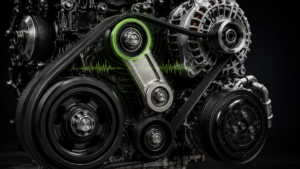
The accessory drive itself introduces additional excitation through belt slip events, tensioner oscillation, and alternator rotor inertia effects during speed transients.
Road inputs arrive through the tire-wheel interface as both broadband rolling noise and discrete transient events from surface irregularities. Aerodynamic sources, such as wind noise and buffeting from mirrors and A-pillars, become significant above 100 km/h and are increasingly important as powertrain NVH is reduced in electrified vehicles. Driveline sources, including gear rattle, axle whine, and propshaft imbalance, contribute under specific vehicle speed and gear combinations that are identifiable through order analysis.
Transfer Paths: Structure-Borne and Air-Borne
Structure-borne NVH travels as mechanical vibration through solid connections, including engine mounts, subframe bushings, suspension components, and the body structure itself. Each interface between components is a potential amplification or attenuation point, depending on its stiffness and damping characteristics.
Airborne NVH travels as acoustic pressure waves through seals, gaps, and body panels that lack sufficient mass or damping to block transmission. Modern vehicle development uses transfer path analysis (TPA) to quantify the contribution of each path to interior noise and vibration levels, making it possible to prioritize interventions based on engineering impact and cost.
Components That Have the Most Leverage on NVH Performance
Not every component contributes equally to NVH outcomes. Some reduce energy at the source, while others interrupt transmission along the path. A well-designed NVH system uses both, placed strategically within the energy transfer chain.
1. Crankshaft Torsional Dampers
The torsional damper at the front of the crankshaft is the primary source-reduction component for engine-originated NVH. It attenuates the angular oscillations created by combustion pressure events before they propagate into the belt drive and accessory systems.
Rubber dampers work well in moderate environments. Viscous dampers, which use silicone oil to dissipate energy across a broader frequency range, are preferred in high-load, high-temperature diesel applications where rubber durability and frequency becomes a limitation. Correct damper selection starts with torsional vibration analysis (TVA); without that data, the specification is largely a guess.
2. Alternator Decoupler Pulleys
The alternator is often overlooked as an NVH source, but its rotor inertia creates significant belt tension fluctuations during engine speed transients, particularly during deceleration and in stop-start cycles.
A solid pulley transmits all of this directly into the belt drive. An alternator decoupler pulley (ADP) incorporates a torsional spring isolator and a one-way clutch, allowing the alternator rotor to overrun during deceleration and decouple its inertia from the system.
The result is reduced belt tension variation, fewer slip events, quieter operation, and improved durability. In start-stop vehicles, where these transients occur frequently, the NVH and durability benefits of an alternator decoupler pulley are substantial.
3. Engine Mounts and Subframe Bushings
Mounts and bushings act as the primary path-interruption components between the powertrain and the vehicle body. Their static stiffness must be high enough to control powertrain motion under load, while their dynamic stiffness must be low enough to isolate vibration in the frequency range that matters for cabin comfort, typically between 5 and 200 Hz.
Hydraulic mounts provide frequency-dependent characteristics that cannot be achieved with rubber alone. Balancing isolation and control remains one of the key challenges in NVH tuning.
4. Tensioners and Belt Drive System Components
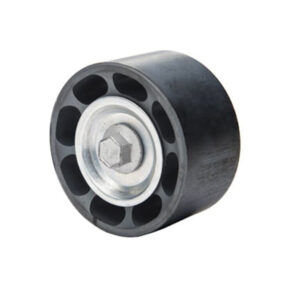
The belt tensioner maintains proper belt tension under varying load conditions. Its spring and damping characteristics determine how effectively it absorbs belt vibrations and prevents resonance.
An undersized tensioner can lead to belt slip during high-load events, while an overly stiff or overdamped design can transmit vibration into the engine structure. A system-level approach, where the damper, decoupler, tensioner, idler, and belt are optimized together, consistently delivers better results than selecting components independently.
How NVH is Measured and What the Data Tells You
NVH measurement relies on accelerometers, microphones, force sensors, and laser vibrometers to capture vibration and noise characteristics across the vehicle.
The primary tool is frequency-domain analysis, which converts time-based signals into spectra to identify where energy is concentrated. Order analysis extends this by linking vibration to engine speed, helping identify which components or excitation orders are responsible for specific issues.
Interior noise is typically measured as sound pressure level (SPL) in dB(A) at the driver’s ear position. Vibration is measured at key contact points, such as the steering wheel and seat rails, in units like m/s² or mm/s.
These measurements are compared against defined targets, and gaps between measured and desired performance guide engineering improvements. Benchmarking against competitor vehicles is also standard practice.
NVH Priorities Differ Between Light and Heavy-Duty Vehicles
In passenger vehicles, the primary focus is ride refinement and acoustic comfort. Customers are sensitive to low-frequency booming, mid-frequency road noise, and high-frequency wind noise.
In heavy-duty applications, such as trucks, buses, and construction equipment, priorities shift toward operator fatigue, durability, and low-frequency vibration control over long operating cycles.
While the underlying engineering principles remain the same, the targets, constraints, and environmental conditions differ significantly.
Key NVH Principles to Carry Into Every Program
-
Always characterize the source before selecting a solution; source reduction is more effective than path blocking alone
-
Order analysis helps identify which components drive observed NVH peaks
-
System-level integration outperforms isolated component optimization
-
Thermal conditions and service life are critical, especially in heavy-duty applications
-
Start-stop systems and electrification change NVH behavior, requiring re-evaluation of belt drive and alternator components
The Takeaway
NVH engineering is fundamentally a system-level challenge. Understanding where energy originates, how it travels, and where intervention is most effective allows engineers to move from reactive fixes to structured development.
Components within the accessory drive, such as dampers, decoupler pulleys, and tensioners, are not secondary elements. They often determine whether a vehicle meets NVH targets or requires costly redesign late in development.
If your program involves specifying or evaluating NVH control components across light or heavy-duty platforms, working with suppliers who approach these systems holistically, and support decisions with engineering data, reduces risk and improves outcomes.
About MUVIQ
MUVIQ is a Tier-1 NVH and vibration control component manufacturer serving OEMs across light-duty, heavy-duty, and hybrid powertrain segments. With a global footprint spanning engineering, manufacturing, and R&D, MUVIQ delivers torsional dampers, alternator decoupler pulleys, tensioners, decouplers, and hybrid system solutions engineered to meet the NVH and durability demands of modern vehicle programs.