Diesel engines operate under punishing mechanical conditions. High compression ratios, elevated combustion pressures, and aggressive torque delivery at low RPM create torsional stress patterns that challenge nearly every powertrain component. At the center of managing these forces sits a component that doesn’t always get the attention it deserves: the viscous damper.
In today’s automotive landscape, where manufacturers pursue downsized, turbocharged architectures with expanded torque bands and tighter NVH targets, the margin for error in damper selection has shrunk dramatically. When a damper is properly specified, an engine runs smoother and lasts longer. When it isn’t, problems emerge, crankshaft fatigue, bearing wear, accessory drive failures, and persistent vibration complaints often without an obvious root cause pointing back to the damper itself.
For NVH engineers and technical procurement teams evaluating viscous damper solutions for heavy-duty diesel applications, the path forward is clear: select a partner who understands not just the component, but the system-level dynamics that govern its performance. This guide walks through that journey from understanding torsional behavior to making damper selections with real engineering confidence.
What Makes Diesel Torsional Vibration So Challenging
Every reciprocating engine generates torsional vibration that’s a given. Diesel engines, however, do so with far greater intensity and complexity than gasoline counterparts. The combustion process in a diesel is explosive: fuel ignites and releases energy rapidly over a small crank angle window. This creates sharp torque spikes that travel through the crankshaft as torsional waves.
At lower engine speeds, particularly in small-displacement, high-torque configurations, these pulses arrive slowly enough that the crankshaft cannot dissipate them through natural inertial damping. The result is a system highly prone to resonance. When engine order frequencies align with the crankshaft’s natural torsional frequency, vibration amplitudes spike. In the real world, this shows up as drivetrain rattle, premature belt and pulley wear, crankshaft bearing degradation, and in severe cases, crankshaft cracking near stress concentration points.
This is precisely why a rigorous torsional vibration analysis (TVA) isn’t option at all it’s the foundation. Without accurate TVA data, damper selection becomes educated guessing, and guessing in high-load diesel applications rarely ends well.
Seven Critical Criteria for Viscous Damper Selection
Selecting a viscous damper isn’t a procurement decision pulled from a supplier catalog. It demands a clear understanding of both engine dynamics and damper behavior. Here are the key criteria that separate a good damper choice from a problematic one.
1.Torsional Amplitude Mapping
Start with accurate torsional vibration data across the full RPM range. You need peak angular displacement values captured under realistic load conditions; these reveal resonance zones the damper must control. Many programs rely on generic dampers because they skip this step. The cost of that shortcut shows up months or years later in warranty claims and field failures. Good TVA data is non-negotiable.
2. Inertia Ring Sizing and Mass Ratio
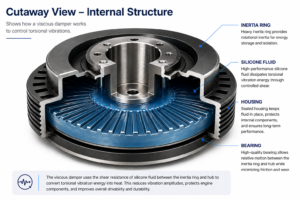
A viscous damper works by coupling a heavy inertia ring to the crankshaft hub through a thin silicone fluid film. The ratio between the ring’s inertia and the crankshaft’s inertia is a core tuning parameter. Too little ring inertia, and you get insufficient energy absorption, vibration passes through uncontrolled. Too much, and you shift the natural frequency unfavorably while adding rotating mass where you don’t need it. The right balance depends on which torsional mode you’re targeting and the engine’s overall inertia distribution. This is where system-level thinking matters.
3.Fluid Viscosity and Thermal Stability
The silicone fluid inside the damper is not a passive filler; it directly controls damping performance. Viscosity determines how efficiently the rotating inertia ring converts vibration energy into heat as it slides relative to the hub. In diesel applications, operating temperatures often exceed 120°C (250°F). Thermal stability is critical. Fluid that breaks down under heat loses viscosity, reducing damping effectiveness exactly when the engine is under peak load. Always verify the damper is rated for continuous operation across your actual operating temperature window, and confirm viscosity stability across that range.
4.Engine Order Targeting
Not all torsional vibrations damage engines equally. In four-cylinder diesels, dominant orders typically include 0.5, 1.0, and second-order harmonics. Six-cylinder designs often see third-order become significant. Below 2,000 RPM, the second order (in 4-cyl) or higher orders (in 6-cyl) often carry the most destructive energy. Your TVA results should point you to the critical frequency bands. The damper must be selected or tuned to attack these orders with maximum effectiveness.
5.Packaging and Integration
Physical constraints matter more than you might expect. The damper must fit within available space, maintain proper pulley alignment, and avoid introducing new vibration into the accessory drive. In many diesel platforms, the damper also serves as a pulley. In those cases, runout tolerances are tight and critical. A poorly integrated damper doesn’t just fail to damp, it can become a vibration source, making NVH worse than if no damper were there at all.
6.Endurance and Service Life
Viscous dampers do degrade over time that’s inherent to the design. How they degrade depends on engineering. Larger bolt-together dampers (typical on engines 30L and above) use seals that can allow fluid migration over extended service. Smaller dampers (2–4 cylinders) typically use laser-welded housings designed to prevent leakage entirely. Secondary degradation occurs through viscosity shift over time and internal wear at bearing interfaces. For heavy-duty diesel engines, damper lifespan must align with major overhaul intervals. Many OEMs now demand endurance validation hundreds of hours at elevated temperature and realistic load conditions before sign-off.
7.Supplier Engineering Capability
The supplier is as important as the component itself. A reliable damper partner should offer torsional insertion loss data (measured or simulated), system-level design support, and tight tolerance drawings backed by capable manufacturing. If a supplier’s answer is ‘here’s a catalog damper, use it,’ that’s a warning sign, especially in high-load applications. You need a partner who understands your TVA, can discuss trade-offs, and validates the solution end-to-end.
Common Pitfalls That Signal Trouble
Over years of working with OEMs and Tier-1 suppliers, certain mistakes appear repeatedly. Reusing dampers from previous engine designs without conducting fresh TVA is one. Small configuration changes bore diameter, compression ratio, combustion chamber design can shift torsional behavior significantly. Ignoring real-world thermal conditions is another. A damper specified for 80°C continuous operation will degrade quickly in a platform that runs at 130°C under load. Finally, underestimating supplier capability is a persistent issue. Choosing a vendor based purely on cost, without evaluating their system-level validation depth, often results in field problems that become expensive to address after production launch.
Bringing It Together
Damper selection is not a procurement task it’s an engineering decision. It requires accurate torsional data, a solid grasp of system dynamics, and careful evaluation of damper properties and real-world integration. In high-load diesel platforms, getting this right directly impacts engine durability, NVH performance, and long-term reliability.
The good news: when you invest in proper analysis and partner with suppliers who take system-level validation seriously, the returns are significant. Smoother engines. Fewer warranty claims. Better customer satisfaction. And the confidence that your damper choice will perform as intended, season after season, mile after mile.
About MUVIQ
MUVIQ is a Tier-1 specialist in NVH and vibration control systems for automotive drivetrains. Working directly with OEM and Tier-1 engineering teams, MUVIQ bridges the gap between torsional vibration analysis and real-world damper selection. From simulation and design validation to manufacturing support, the focus is straightforward: help engineering teams make the right damper decision with confidence. Whether you’re specifying a new diesel platform or troubleshooting an existing NVH issue, visit MUVIQ to explore damper solutions and connect with our engineering team.
Ready to Optimize Your Damper Selection?
Let our engineering team review your TVA data and recommend the damper solution that fits your platform. Contact MUVIQ to discuss your project.